Mvet
The sung epic of the Ekang peoples, and the harp-zither that accompanies it
Period : An ancient tradition of uncertain origin; inscribed by UNESCO in 2025 · The Ekang peoples: Fang, Beti and Bulu
Also spelt : Mvett, Mver, Mvet Oyeng
What is it?
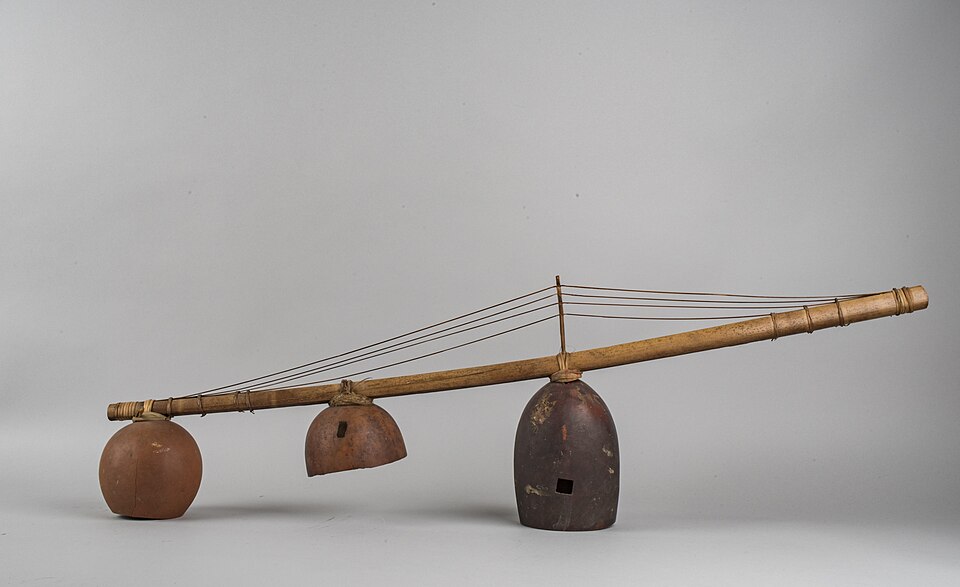
The word mvet refers both to a stringed instrument, a kind of harp-zither, and to the long epic narratives it accompanies. The player, known as the mbom-mvet, is an initiated bard who recites, sings and dances these epics. The art is shared by the Fang, Beti and Bulu, notably in Cameroon, Gabon and Equatorial Guinea.
History and origin of the name
The origin of the mvet, like that of the Fang, is little known. According to legend, during these peoples' migration the warrior and musician Oyono Ada Ngone fell into a week-long coma, during which a spirit, Eyo, gave him the instrument and the stories of the Ekang's great deeds; on waking, he built it. The name is said to come from the verb "a vet", "to rise".
Rhythm, instruments and dance
- A collective performance: the audience accompanies the bard by clapping, singing and exchanging lines with him. The mvet has a sacred form, reserved for major ceremonies, and a popular form played at celebrations.
- A stick zither of raffia or bamboo, one to two metres long, usually fitted with three calabash resonators; a central bridge divides four or five strings, plucked on both sides. The musician holds it horizontally against the chest.
- Epics set in an imaginary world where the immortal people of Engong, led by Akoma Mba, fight the mortals of Oku; they pass on lineage memory and values such as courage, honour and solidarity.
Key artists
- Daniel Osomo Meva'a — described by Cameroon Tribune as one of the greatest mvet players of southern Cameroon.
- Samuel-Martin Eno Belinga — a poet and musicologist born in Ebolowa (1935-2004), who in 1967 recorded a ritual mvet performed by Daniel Ossomo, now held in the CNRS sound archives.
- Tsira Ndong Ndoutoume — author of "Le Mvett : épopée fang", which tells the legend of Oyono Ada Ngone, and of "Le Mvett : l'homme, la mort et l'immortalité" (1993).
- Pierre Alexandre — author in 1974 of a study of the mvet of Gabon and Cameroon, published in the Bulletin of the School of Oriental and African Studies in London.
Today
On 10 December 2025, "Mvet Oyeng, musical art, practices and skills associated with the Ekang community" was added to the Intangible Cultural Heritage of Humanity at the 20th session of the UNESCO committee in New Delhi, on a joint nomination by Cameroon, Gabon and the Congo. Among the Beti, mvet evenings traditionally come before the looser bikutsi phase.
What sources disagree on
The etymology of the word is given by only one source. For the UNESCO inscription, the Cameroonian and Gabonese press give 10 December 2025 and three countries, but another outlet cites 11 December and five countries, adding Equatorial Guinea and São Tomé and Príncipe.