Bikutsi
The music that "beats the earth", from Beti country
Period : An old dance, modernised from the 1950s to the 1980s · The Beti, including the Ewondo of the Yaoundé area
What is it?
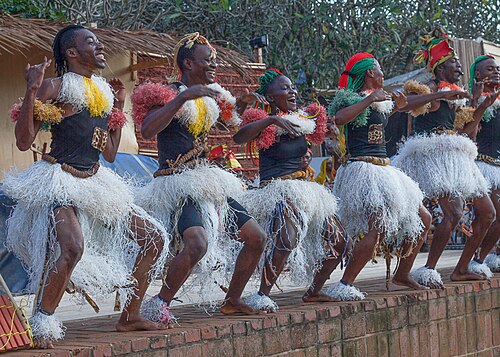
Bikutsi is a music and dance from Cameroon, born among the Beti of the Centre region, around Yaoundé. A fast, highly percussive dance music, it accompanies parties, weddings and funerals. In its modern, electrified form it rivals makossa as the country's best-known style.
History and origin of the name
In Ewondo the word means "to beat the earth": "kut" means to strike and "si" the ground, a reference to the dancers' feet stamping the floor. It began as women's music: gathered in a circle, they sang of their sorrows and grievances while clapping or striking rattles and split bamboo, at a time when they were denied a public voice. With migration to Yaoundé, balafon orchestras brought it into the city's bars from the 1950s.
Rhythm, instruments and dance
- A fast triple-time rhythm in 6/8, split into two groups of three, occasionally 9/8, once kept by feet and hands and now by drum kit and percussion.
- The balafon, played in orchestras of three to five instruments, then the electric guitar, its strings damped with cotton thread or foam so that it sounds like a balafon.
- Female choruses, shouts and energetic dancing; the lyrics deal with everyday life, relationships and sexuality, often ironically, which has drawn criticism of the genre for its explicitness.
Key artists
- Anne-Marie Nzié — nicknamed "the queen mother of bikutsi", born in 1932 in Lolodorf, died in 2016, she made the genre known across the country.
- Messi Me Nkonda Martin — singer and guitarist of the band Los Camaroes, described as the father of modern bikutsi for transferring the sound of the balafon to the electric guitar.
- Les Têtes Brûlées — a band founded in Yaoundé by Jean-Marie Ahanda that took bikutsi to Europe and Japan; their French tour was filmed by Claire Denis in "Man No Run" (1989).
- Les Vétérans — one of the most popular bikutsi bands of the 1970s and 1980s.
- K-Tino — a leading name in contemporary bikutsi, now performed largely by women, who styles herself a "woman of the people".
Today
Bikutsi remains one of Cameroon's most popular genres, carried by singers such as Lady Ponce and K-Tino, and mbolé, an urban style popular since 2015, draws heavily on it. Its suggestive lyrics and dancing remain controversial. Abroad, Paul Simon drew on it for his album "The Rhythm of the Saints" (1990).
What sources disagree on
Sources disagree on dates: the genre's first popular successes are placed in the 1940s or the 1950s, and the founding of Les Têtes Brûlées in the mid-1980s or specifically in 1987. The "balafon-style" guitar is credited sometimes to Messi Martin, sometimes to the Têtes Brûlées guitarist Zanzibar.